


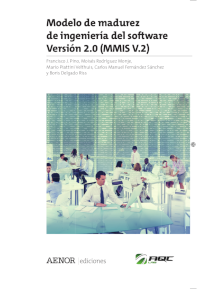
AQCLab and AENOR have released the new Modelo de Madurez de Ingeniería del Software (Software Engineering Maturity Model), Version 2.0 (MMIS V.2)
This book presents AENOR's Software Engineering maturity model, MMIS v2.0, which is based on the new family of standards ISO/IEC 33000, which has replaced the old family of standards ISO/IEC 15504 (SPICE), and on the new version of ISO/IEC 12207:2017. In addition, the book aims to be a tool for the implementation and use of these standards with the goal of achieving more agile and efficient software processes, resulting in better quality products and services.
The MMIS v2.0 model has already been implemented in several organizations, one of which is Telefonica, who carried out the improvement of their software development processes, and the other one is Biblioteca de la Universidad de Castilla La Mancha, who carried out the improvement of their data Governance, Management and Quality processes.
You can purchase the book in your preferred format (PDF, EPUB or Paper) at AENOR's website.

The radio program "Investiga Que No Es Poco" featured an interview with the scientific director of AQCLab, professor of the University of Castilla-La Mancha and founder/director of the Alarcos Research Group, Dr. Mario piattini.
The interview revolved around the importance of software and, in particular, data in today's society, in which our well-being and our way of relating to our environment depend to a large extent on the quality of the information systems we use daily. The interview discusses the quality of data as a key element to extract useful information to help make appropriate decisions in organizations, as well as the criticality of security and privacy of data, the importance of training software engineers that can adapt to market needs, and also the current and future state of the ITC sector.
The program aired on the 13th of May, and you can listen to the podcast on the website of CMMedia (in Spanish).
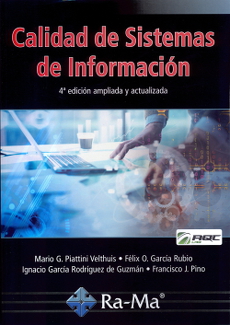
AQCLab participates in the 4th edition of the book "Calidad de Sistemas de Información" (Quality of Information Systems), written by the Scientific Director of AQCLab, Mario Piattini, together with the colleagues form the Alarcos Research Group Felix García, Ignario Rodriguez and Francisco Pino.
This book comprehensively addresses the different elements that impact the quality of information systems and the different points of view to approach them:
Thus, "Calidad de Sistemas de Información" brings together the different aspects of quality related to these different elements, offering a current and complete overview of various models and standards that can be followed to achieve quality information systems, combining scientific rigor with hands-on experience.
Telefónica has obtained the first certificate worldwide of conformance to ISO/IEC 33000 and ISO/IEC 12207:2017, which has been issued by AENOR. These standards are aimed to evaluate the the Maturity of the Software Life Cycle Processes, and Telefónica has reached a level 3 of maturity after the evaluation carried out by the auditors of AENOR.
With this milestone, Telefónica becomes the first organization to achieve the new certification ISO 33000 for the maturity in the development of software, which will soon be replacing and applying to the rest of the companies that are currently certified in conformance to the previous ISO/IEC 15504 standard.
From here, AQCLab wants to congratulate both Telefónica, for the milestone achieved, and the AENOR audit team, of which AQCLab has been part.

Javier Magdalena, director of Digital Business of Telefónica, and Manuel Romero, director of Sectorial Marketing of AENOR, during the official delivery of the certificate
After the first success cases with the MAMD data process management model and the evaluation of data quality in conformane to ISO/IEC 25000, which led to the issue of the first certificate to ICEMD, ComputerWorld University conducts an interview to our scientific director Mario Piattini in which they talk about the models defined in collaboration between AENOR, AQCLab and DQTeam for evaluating, improving and certifying data quality.
In the interview, focused on the relevance of Data as the most important asset of an organization, it is also discussed the growing importance that data is acquiring with the new SMACT technologies (Social, Mobile, Analytics and Big Data, Cloud Computing and Internet of Things) and digital transformation, every day more present in organizations.
Another point that is debated is the need to manage data quality and implement data governance in order to ensure that data is reliable and that processes where data is managemd and used are aligned with the objectives of the organization, as well as as the role of the CDO (Chief Data Officer) as responsible for said quality and governance of the data.
You can listen to the interview (in Spanish) in ComputerWorld University.
 +34 676 97 57 83


